
About octop
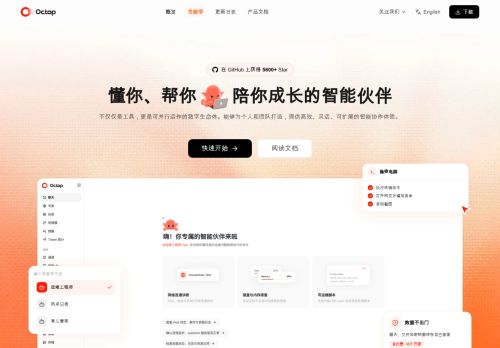
Octop is a self-hosted, open-source AI assistant platform licensed under MIT. It runs per-user assistant instances that operate in parallel and can assume different roles.
Octop integrates with editors, terminals, and external accounts to read and update documents, run commands, interact with web pages, fill forms, and capture screenshots. Agents automate multi-step workflows and return results for user review, with role switching available without changing the environment.
Installation supports one-step commands, container or pip deployment, and desktop clients for major operating systems. Source code and documentation are available on GitHub for self-hosted deployment and customization.
Key Features
Use Cases
Who is it for?
Octop integrates with editors, terminals, and external accounts to read and update documents, run commands, interact with web pages, fill forms, and capture screenshots. Agents automate multi-step workflows and return results for user review, with role switching available without changing the environment.
Installation supports one-step commands, container or pip deployment, and desktop clients for major operating systems. Source code and documentation are available on GitHub for self-hosted deployment and customization.
Key Features
- Self-hosted open-source AI assistant platform (MIT license)
- Per-user assistant instances that run in parallel and support role switching without changing the environment
- Integrations with editors, terminals, and external accounts to read/update documents, run commands, interact with web pages, fill forms, and capture screenshots
- Agents that automate multi-step workflows and return results for user review
- Multiple installation and deployment options: one-step commands, container or pip deployment, and desktop clients for major operating systems
Use Cases
- Automate end-to-end developer workflows with Octop by running tests, refactoring code inside your editor, opening PRs and merging via terminal commands, and capturing annotated screenshots for pull-request reviews—self-hosted per-user assistants keep secrets private while role-switching simulates reviewer and maintainer perspectives
- Manage deployments and incident response using Octop's multi-step workflow agents to run SSH/terminal commands, roll back releases, update cloud dashboards and notify stakeholders, while role-based assistants and web-account integration let operators safely inspect and modify live systems without exposing credentials
- Create and maintain product documentation and how-to guides by letting Octop read and update docs in your editor, capture and embed in-app screenshots, automate publishing to your website and CMS, and switch to a reviewer role to validate copy and links before release—all on a self-hosted, open-source assistant instance
Who is it for?
- Software developers
- Devops / site reliability engineers
- Data scientists & machine learning engineers
- Qa engineers / test automation engineers
- Technical writers & documentation engineers
- It administrators / system administrators
- Security-conscious teams & privacy-focused organizations
- Automation engineers & power users
- Researchers & computational scientists
- Product managers & pms
No review yet!
More AI Agents AI Tools
Explore other ai agents tools with user ratings, pricing details, and in-depth descriptions. Updated regularly by our editorial team.