
About Muse Wonder
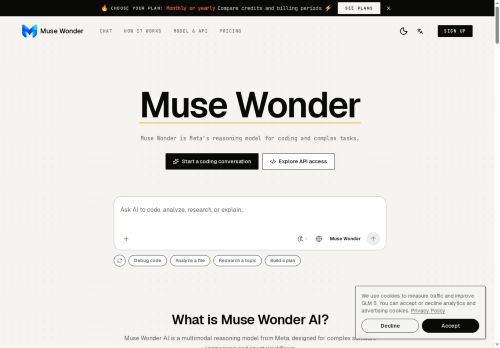
A multimodal reasoning model from Meta for coding and complex agent workflows.
Accepts text, images, video, audio and document inputs upstream and produces text-based responses for analysis and code generation.
Supports a large context window for reasoning over extensive codebases and conversation history.
Provides tool-call support and structured output formats to integrate reasoning with external services and automation.
Delivers code explanation, debugging guidance, refactoring suggestions, implementation plans and patch reviews.
Accessible via a web chat interface and an OpenAI-compatible API with configurable reasoning effort.
Key Features
Use Cases
Who is it for?
Accepts text, images, video, audio and document inputs upstream and produces text-based responses for analysis and code generation.
Supports a large context window for reasoning over extensive codebases and conversation history.
Provides tool-call support and structured output formats to integrate reasoning with external services and automation.
Delivers code explanation, debugging guidance, refactoring suggestions, implementation plans and patch reviews.
Accessible via a web chat interface and an OpenAI-compatible API with configurable reasoning effort.
Key Features
- Accepts text, images, video, audio and document inputs and produces text-based responses for analysis and code generation
- Supports a large context window for reasoning over extensive codebases and conversation history
- Provides tool-call support and structured output formats to integrate with external services and automation
- Offers code-focused capabilities: code explanation, debugging guidance, refactoring suggestions, implementation plans and patch reviews
- Accessible via a web chat interface and an OpenAI-compatible API with configurable reasoning effort
Use Cases
- Refactor large legacy codebases using Muse Wonder's large-context reasoning and multimodal inputs (source code, design docs, screenshots) to generate context-aware refactors, automatic unit tests, and ready-to-apply patch reviews via an OpenAI-compatible API
- Diagnose and fix complex bugs by feeding Muse Wonder crash logs, stack traces, screen recordings, and repository snapshots to produce step-by-step debug plans, reproducible test cases, and concrete patches with tool-call integration to run and validate fixes
- Automate end-to-end developer workflows—use Muse Wonder to run code reviews, generate PR descriptions, apply fixes, run CI checks, and orchestrate agent workflows across issue trackers and CI/CD tools using multimodal reasoning and tool-call support for continuous code quality
Who is it for?
- Software engineers
- Full-stack developers
- Machine learning engineers
- Data scientists
- Devops and sre engineers
- Qa engineers and testers
- Technical leads and engineering managers
- Api integrators and platform engineers
- Tool builders and automation engineers
- Developers performing code review and refactoring
No review yet!
More Code assistant AI Tools
Explore other code assistant tools with user ratings, pricing details, and in-depth descriptions. Updated regularly by our editorial team.