
About Reasonix
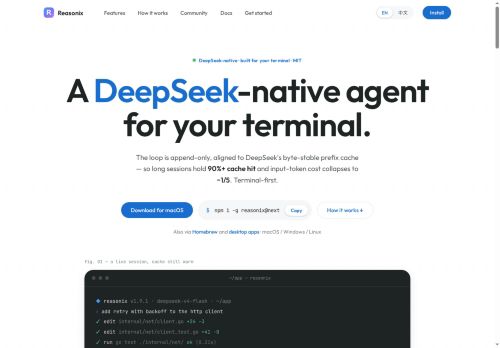
The tool is distributed as a single Go binary (cgo-free) cross-compiled for macOS, Linux, and Windows on amd64 and arm64, with no Node runtime required.I/O supports stdio, SSE, and streamable HTTP, and external servers can merge tools into a unified registry.
Plan mode and sandboxing provide jailed workspaces and read-only approval gates for controlled write operations.Subagents and skill scripts enable isolated workflows for exploration, research, review, and security-review tasks.
Terminal-native integration treats git diff and ls as workspace controls, maps codebases to keep the prefix cache warm, and lets sessions run continuously and resume without cold starts.The project is MIT-licensed and requires a Deepseek API key; code and model interactions remain local to the machine.
Key Features
- Terminal-native persistent coding agent with continuous sessions and resume capability
- Append-only, cache-first loop aligned with Deepseek byte-stable prefix cache
- Single cgo-free Go binary cross-compiled for macOS, Linux, and Windows on amd64 and arm64 (no Node runtime)
- I/O via stdio, SSE, and streamable HTTP with external servers able to merge tools into a unified registry
- Plan mode and sandboxing providing jailed workspaces and read-only approval gates for controlled write operations
Use Cases
- Maintain persistent developer sessions to iteratively refactor and test large codebases in sandboxed workspaces using Reasonix's append-only, byte-stable prefix cache (90%+ cache hits) to slash input-token billing to about one-fifth while enabling fast local-model-driven code transforms
- Run isolated subagent workflows for automated CI tasks—linting, security scans, test generation, and pull-request drafting—using Reasonix's single-binary distribution and sandboxing so engineers can self-host reproducible automation with minimal overhead
- Enable rapid onboarding and collaborative debugging by sharing persistent terminal sessions and cache-first context so new team members and reviewers can instantly pick up state, interact with local models for explanations and fixes, and avoid re-sending full context
Who is it for?
- Terminal-first developers
- Backend engineers
- Devops engineers
- Tooling/cli developers
- Security engineers
Based on 7 verified user reviews — Average rating: 3.29/5

@seanhoward9267
TurkeyNeeds serious improvement. Slow, inconsistent, and customer support was unhelpful.

@frankrobinson6330
TurkeyWhat surprised me about Reasonix is how little friction there is once you set preferences. I keep a short checklist: audience, tone, must-include points, and forbidden phrases. With that, outputs are consistently usable. Without it, results feel generic. I also like that I can iterate quickly instead of restarting from a blank page. Missing features for me: better version history and clearer export options. Even so, it has replaced a couple of scattered tools in my stack. Rating reflects practical value in my week, not hype from the landing page.

@jeffreymartinez7308
TurkeyReasonix umut verici. Birkaç özellik eksik olsa da çekirdek deneyim güçlü.


@christinehall8154
TurkeyDetailed take after daily use: Reasonix is strongest on speed and decent on quality when the brief is clear. I tested it against two alternatives on the same tasks (blog outline, meeting notes cleanup, and a short product FAQ). Reasonix was the fastest and produced the least awkward tone. Weak points are edge cases — niche jargon and multi-step instructions sometimes drift. I solved that with a saved prompt style guide. Pricing is okay if you actually use it several times a week; otherwise the free tier may be enough. Overall I would recommend it to freelancers and small teams who need reliable first drafts, not final publish-ready copy every time.

@juancooper4673
TurkeyŞimdilik fiyat/performans dengesi iyi. Ücretsiz sürüm değerlendirmek için yeterliydi.
More Code assistant AI Tools
Explore other code assistant tools with user ratings, pricing details, and in-depth descriptions. Updated regularly by our editorial team.