
About Heretic
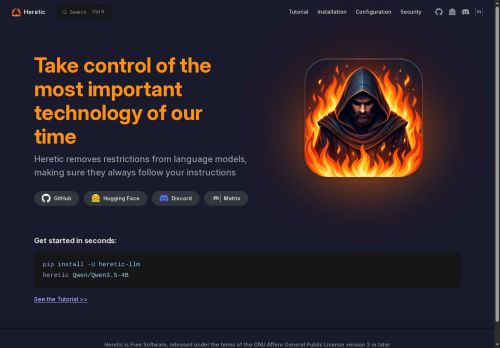
heretic implements multiple ablation and analysis methods, including directional ablation (Arditi et al., 2024), projected abliteration (Lai, 2025), MPOA (Lai, 2025), experimental SOMA (Piras et al., 2025), and ARA (Weidmann, 2026).
Integrations include Hugging Face model hosting and community repositories (GitHub), with command-line usage examples such as heretic qwen/qwen3-4b-instruct-2507 and pip install support.Designed for researchers and engineering teams, heretic enables reproducible experiments, model introspection, and configurable instruction-following behavior.
Common use cases include ablation studies, benchmarking, model evaluation, and building custom inference workflows for research and production environments.
Key Features
- Customizing, ablation testing, and evaluation of large language models
- Support for dense, MoE, and hybrid model architectures
- Built-in chat interface, benchmark runner, and model testing utilities
- Implements multiple ablation/analysis methods (directional ablation, projected abliteration, MPOA, SOMA, ARA)
- Integrations with Hugging Face and GitHub, command-line usage and pip install (Python 3.10+)
Use Cases
- Run rigorous ablation studies on dense and MoE/hybrid LLMs using heretic to pinpoint which components drive performance, leverage built-in model introspections and analysis methods, and export reproducible experiment artifacts integrated with Hugging Face and GitHub for publication-ready results
- Build and iterate custom inference workflows and hybrid MoE deployments with heretic's CLI/pip support and built-in chat interface to rapidly prototype, debug via live model introspection, and version pipelines in GitHub for reproducible production rollouts
- Benchmark and compare candidate LLMs across standardized datasets using heretic's benchmark runner to automate multi-model evaluations and ablation sweeps, generate shareable performance reports, and make data-driven model selection and hyperparameter decisions
Who is it for?
- Model developers
- Ml engineers
- Research scientists
- Benchmarking teams
- Data scientists
Based on 8 verified user reviews — Average rating: 4.13/5

@bobbygreen535
TurkeyGünlük kullanım sonrası detaylı yorum: Heretic hız konusunda güçlü, brief netse kalite de iyi. Aynı görevlerde iki alternatifle kıyasladım (blog outline, toplantı notu sadeleştirme, kısa SSS). Heretic en hızlısıydı ve tonu en az garip olandı. Zayıf yanı uç vakalar — niş jargon ve çok adımlı isteklerde sapabiliyor. Bunu kayıtlı bir stil/prompt rehberiyle çözdüm. Haftada birkaç kez kullanıyorsanız fiyatı makul; değilse ücretsiz katman yetebilir. Freelancer ve küçük ekiplere, güvenilir ilk taslak için öneririm.
@alberto
TurkeyBenim kullanım alanıma yeterince isabetli. Destek dönüşleri de makul sürede geldi.

@bobbywilson949
TurkeyDetailed take after daily use: Heretic is strongest on speed and decent on quality when the brief is clear. I tested it against two alternatives on the same tasks (blog outline, meeting notes cleanup, and a short product FAQ). Heretic was the fastest and produced the least awkward tone. Weak points are edge cases — niche jargon and multi-step instructions sometimes drift. I solved that with a saved prompt style guide. Pricing is okay if you actually use it several times a week; otherwise the free tier may be enough. Overall I would recommend it to freelancers and small teams who need reliable first drafts, not final publish-ready copy every time.


@noahrichardson3158
TurkeyBenim kullanım alanıma yeterince isabetli. Destek dönüşleri de makul sürede geldi.

@annramos5200
TurkeyHeretic umut verici. Birkaç özellik eksik olsa da çekirdek deneyim güçlü.
More LLM AI Tools
Explore other llm tools with user ratings, pricing details, and in-depth descriptions. Updated regularly by our editorial team.