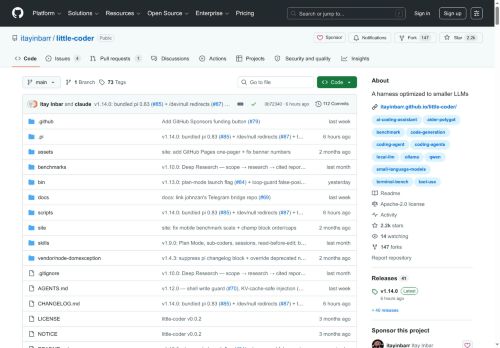

About Little-Coder
Core mechanisms preserved from the whitepaper include the write-vs-edit invariant, per-turn skill injection, algorithm-cheat-sheet injection, thinking-budget cap, output parsers, quality monitor, per-model profiles, and evidence-aware compaction.
The repository contains a Pi port, build and serve instructions for llama.cpp (GPU and MoE options), Ollama setup, model fetching steps, and reproducible tags for reported benchmark runs.Developers and researchers can use little-coder for local code generation, on-device development, model benchmarking, and reproducing published results with included configs and documentation.
Benchmarks and whitepaper documents support evaluation across local LLMs such as Qwen variants and custom GGUF models.Quick-start steps and scripts facilitate setup on laptops, GPUs, and Raspberry Pi devices for integrated developer workflows and edge deployments.
Key Features
- Runs local small LLMs via llama.cpp or Ollama (Pi-based coding agent)
- Python and Node.js CLIs plus TypeScript extensions for local cloud-style coding agent workflows
- Core agent mechanisms: write-vs-edit invariant, per-turn skill injection, algorithm-cheat-sheet injection, thinking-budget cap, output parsers, quality monitor, per-model profiles, evidence-aware compaction
- Build/serve instructions and scripts for llama.cpp (GPU and MoE) and Ollama, plus model fetching and reproducible benchmark tags
- Benchmarking and evaluation support for local LLMs (e.g., Qwen variants and custom GGUF models) with reproducible configs and documentation
Use Cases
- Build an offline on-device coding assistant on a Raspberry Pi using little-coder's Python/Node CLIs and TypeScript extensions to generate, run, and debug code locally with 5–25 GB LLMs (llama.cpp or Ollama) while using evidence-aware compaction for more reliable suggestions
- Run reproducible benchmarks to compare low-memory LLMs and optimize edge deployments using little-coder's benchmark suite and build/serve guides, producing repeatable performance reports to pick the best model for constrained hardware
- Automate secure local code generation and evaluation in CI/CD by integrating little-coder's CLI developer workflows and on-device evaluation tools to produce audited, reproducible artifacts for edge LLM deployment without sending code to the cloud
Who is it for?
- Local llm developers
- Embedded developers
- Benchmark engineers
- Reproducibility researchers
- Students
Based on 3 verified user reviews — Average rating: 4.33/5

@nathanmiller545
TurkeyLittle-Coder araçını birkaç haftadır gerçek işlerde deniyorum; sadece demo değil. İlk hafta prompt alışkanlığı kazanmakla geçti. Sonrasında özellikle taslak, e-posta yanıtı ve özet işlerinde süre belirgin düştü. Kusursuz değil: uzun metinlerde yapı bozulabiliyor ve kritik noktaları mutlaka kontrol ediyorum. Yine de yoğun bir haftada düşünmeden açtığım araçlardan biri oldu. Net bir iş akışınız varsa Little-Coder kolay oturuyor. Sıfır düzenlemeyle sihir bekliyorsanız hayal kırıklığı olur. Benim için sıkıcı ara adımları kısaltması yeterli sebep.

@dianelewis3175
TurkeyWhat surprised me about Little-Coder is how little friction there is once you set preferences. I keep a short checklist: audience, tone, must-include points, and forbidden phrases. With that, outputs are consistently usable. Without it, results feel generic. I also like that I can iterate quickly instead of restarting from a blank page. Missing features for me: better version history and clearer export options. Even so, it has replaced a couple of scattered tools in my stack. Rating reflects practical value in my week, not hype from the landing page.

@elijahjohnson6191
TurkeyAccurate enough for my use case. Support responses were also reasonably quick.

More Code assistant AI Tools
Explore other code assistant tools with user ratings, pricing details, and in-depth descriptions. Updated regularly by our editorial team.