
About How LLMs work
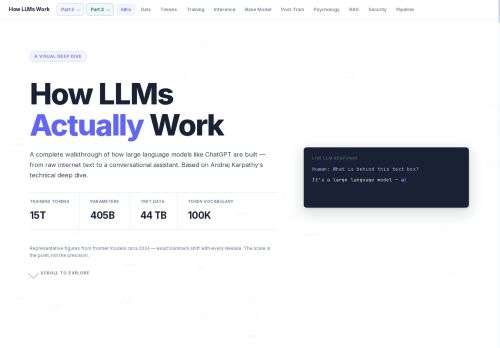
The resource documents data preparation steps—web crawling, language filtering, deduplication, and PII removal—and references representative corpora such as FineWeb and Common Crawl.It explains tokenization approaches like byte pair encoding (BPE), tokenizer vocabularies, and how token embeddings feed multi-head attention and transformer blocks.
Training topics include loss measurement, parameter updates across billions of parameters, and practical notes on sampling and autoregressive inference.The content targets ML researchers, engineers, data scientists, and students seeking a technical walkthrough of model internals, dataset curation, and deployment considerations.
Visualizations, stepwise walkthroughs, and live examples support debugging, model evaluation, and understanding generation behavior.
Key Features
- Pre-training and model internals coverage (transformer architecture, attention mechanisms)
- Tokenization methods and token embedding pipeline (BPE, tokenizer vocabularies)
- Data preparation pipeline (web crawling, language filtering, deduplication, PII removal)
- Training and inference procedures (loss measurement, large-scale parameter updates, sampling, autoregressive inference)
- Retrieval-augmented generation (RAG) and inference pipeline explanations
Use Cases
- Inspect and debug model behavior by visualizing tokenization (BPE merges), transformer attention maps, autoregressive inference traces and intermediate layer activations with LLMs Work's live examples and visualizations to pinpoint hallucinations, performance bottlenecks, and optimization targets without building custom tooling
- Curate and optimize datasets and RAG pipelines for fine-tuning by using LLMs Work to simulate training dynamics, evaluate retrieval strategies, visualize dataset coverage and failure modes, and generate interpretable metrics that accelerate domain adaptation and reduce trial-and-error
- Onboard engineers, researchers and product teams with interactive visual walkthroughs of LLM internals—pre-training, tokenization, attention mechanics, inference and deployment trade-offs—enabling collaborative debugging, informed architecture decisions, and clearer communication of model limitations to stakeholders
Who is it for?
- Ml researchers
- Engineers
- Data scientists
- Students
Based on 10 verified user reviews — Average rating: 4.30/5

@bruceturner9707
TurkeyHow LLMs work ile ilgili sürpriz, tercihleri ayarladıktan sonra sürtünmenin azalması oldu. Kısa bir kontrol listem var: hedef kitle, ton, zorunlu maddeler, istenmeyen ifadeler. Bunlarla çıktılar düzenli şekilde kullanılabilir oluyor. Olmadan sonuçlar genel kalıyor. Boş sayfadan başlamak yerine hızlıca iterasyon yapabilmek de büyük artı. Eksik gördüğüm yerler: daha iyi sürüm geçmişi ve net export seçenekleri. Yine de dağınık birkaç aracı elimden aldı. Puanım reklam değil, haftalık pratik faydaya göre.

@matthewjohnson386
TurkeySimple, focused, and not bloated. That alone makes it stand out among AI tools.

@nicholasstewart5379
TurkeyClean interface and good output quality. I keep coming back to it for daily tasks.


@kaylahall5374
TurkeyTried How LLMs work for a week and it stuck. Good balance of quality and simplicity.

@ethanphillips5564
TurkeyI have been using How LLMs work for a few weeks on real client work, not just demos. The first week was mostly learning prompts and figuring out which templates stick. After that, drafting time dropped noticeably — especially for outlines, email replies, and first-pass summaries. It is not flawless: long documents sometimes lose structure, and I still fact-check anything important. Still, for a busy week it has become one of the tools I open without thinking. If you already have a clear workflow, How LLMs work fits in cleanly. If you expect magic with zero editing, you will be disappointed. For me, the time saved on the boring middle steps is worth it.
More LLM AI Tools
Explore other llm tools with user ratings, pricing details, and in-depth descriptions. Updated regularly by our editorial team.