
About MDMA
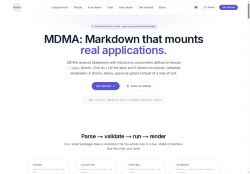
Defines nine interactive component types—form, button, tasklist, table, callout, approval-gate, webhook, chart, thinking—expressed via short YAML-like MDMA blocks and a schema spec.Supports typed fields, validation rules, sensitive flags, role-based sign-off, sortable tables, outbound webhook events, inline charts, and model reasoning traces.
Targets lower token cost workflows by using a markdown-first spec, a deterministic validator to catch structural issues, and an LLM fixer to repair outputs for smaller models.Distributed as modular npm packages (@mobile-reality/mdma-parser, mdma-validator, mdma-runtime, mdma-renderer-react) so teams can parse, validate, run, and render MDMA docs in development or the browser.
Common use cases include contact forms, onboarding checklists, dual-approval compliance flows, sortable data tables, and live agent demos; source code and documentation are on GitHub.
Key Features
- Remark-plugin parser that converts fenced MDMA markdown blocks into an MDMA AST and structured, renderable UI components
- Static validator with lint rules, auto-fix and a deterministic validator to catch structural issues
- Runtime that manages state, data bindings, and audit logs
- React renderer for live, stateful components
- Schema-driven interactive components (form, button, tasklist, table, callout, approval-gate, webhook, chart, thinking) expressed via YAML-like MDMA blocks; supports typed fields, validation rules, sensitive flags, role-based sign-off, sortable tables, outbound webhooks, inline charts, and model reasoning traces
Use Cases
- Create validated, stateful LLM-driven forms and approval workflows from fenced MDMA markdown blocks using the open-source framework, leveraging the parser and static validator with auto-fix to enforce schema, role-based approvals and audit logs to capture decisions, and outbound webhook events to push approvals into downstream systems
- Build embeddable, interactive dashboards and sortable data tables for support or analytics teams by authoring markdown UI components; use the React renderer and stateful runtime to enable live agent interactions, bindings for backend data, audit trails for compliance, and webhook integrations to sync records with CRMs or ticketing systems
- Enable non-developers to author production-ready UI and content pipelines in MDMA markdown by relying on the schema validator to auto-fix errors, the runtime to render stateful LLM-driven interfaces, and role-based approvals plus outbound webhooks to automate publishing and trigger CI/CD or notification workflows
Who is it for?
- Frontend developers
- Full-stack developers
- Ux designers
- Technical writers
- Developer teams
Based on 10 verified user reviews — Average rating: 3.70/5

@anthonykelly8058
TurkeyNice discovery. Documentation could be clearer, but once you learn it, it is productive.

@aiash9109
TurkeyOrtalama bir deneyim. Bazen işe yarıyor, bazen yoruyor.

@brittanysanders455
TurkeyFine for quick drafts. I would not rely on it for final client deliverables yet.


@jeffreydiaz1735
TurkeyReliable enough for production drafts. I edit the output, but the first pass is strong.

@seanalvarez8632
TurkeyGünlük kullanım sonrası detaylı yorum: MDMA hız konusunda güçlü, brief netse kalite de iyi. Aynı görevlerde iki alternatifle kıyasladım (blog outline, toplantı notu sadeleştirme, kısa SSS). MDMA en hızlısıydı ve tonu en az garip olandı. Zayıf yanı uç vakalar — niş jargon ve çok adımlı isteklerde sapabiliyor. Bunu kayıtlı bir stil/prompt rehberiyle çözdüm. Haftada birkaç kez kullanıyorsanız fiyatı makul; değilse ücretsiz katman yetebilir. Freelancer ve küçük ekiplere, güvenilir ilk taslak için öneririm.
More Developer tools AI Tools
Explore other developer tools tools with user ratings, pricing details, and in-depth descriptions. Updated regularly by our editorial team.