
About REA
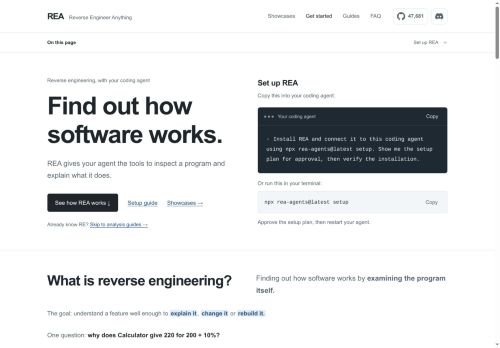
REA (Reverse Engineer Anything) inspects programs and returns decompiled code, selected assembly, call traces, and execution data for analysis. It connects to a coding agent and local debugging endpoints to capture runtime activity and reproduce execution paths.
Capabilities include native binary analysis, JavaScript/Electron module mapping, and browser/runtime observation. REA extracts handlers, constants, branches, and call relationships, then presents readable summaries of control flow and computation rules.
The tool can rebuild recovered logic into small reproductions, run controlled checks to validate rules, and generate step-by-step analysis outputs. Results include decompilations, traced values, and reconstruction guidance that agents can use to explain or reimplement features.
Setup integrates via a CLI installer for the coding agent and supports guided workflows for targeted inspections.
Key Features
Use Cases
Who is it for?
Capabilities include native binary analysis, JavaScript/Electron module mapping, and browser/runtime observation. REA extracts handlers, constants, branches, and call relationships, then presents readable summaries of control flow and computation rules.
The tool can rebuild recovered logic into small reproductions, run controlled checks to validate rules, and generate step-by-step analysis outputs. Results include decompilations, traced values, and reconstruction guidance that agents can use to explain or reimplement features.
Setup integrates via a CLI installer for the coding agent and supports guided workflows for targeted inspections.
Key Features
- Decompile programs and output decompiled code, selected assembly, call traces, and execution data
- Connect to a coding agent and local debugging endpoints to capture runtime activity and reproduce execution paths
- Perform native binary analysis, JavaScript/Electron module mapping, and browser/runtime observation
- Extract handlers, constants, branches, and call relationships and summarize control flow and computation rules
- Rebuild recovered logic into small reproductions, run controlled validation checks, and generate step-by-step analysis outputs
Use Cases
- Analyze and document complex native binaries with REA by automatically decompiling code, capturing runtime traces and call graphs, extracting handlers/constants/branches, and producing compact reproducible snippets and step‑by‑step analyses for vulnerability reports and secure code reviews
- Debug and fix production Electron and JavaScript issues using REA's module mapping and JS runtime inspection to reconstruct control flow, generate execution traces and assembly-level insights, and turn hard-to-reproduce bugs into actionable patches without invasive instrumentation
- Perform rapid malware and incident-response analysis with REA's automated reverse-engineering to extract call relationships, handlers and constants, build small deterministic reproductions for sandboxing, and produce prioritized forensic reports for remediation and attribution
Who is it for?
- Reverse engineers
- Security researchers
- Malware analysts
- Vulnerability researchers
- Incident responders
- Penetration testers
- Digital forensics analysts
- Software engineers (debugging and maintenance)
- Bug bounty hunters
- Threat intelligence analysts
- Security consultants
- Quality assurance engineers
No review yet!
More Developer tools AI Tools
Explore other developer tools tools with user ratings, pricing details, and in-depth descriptions. Updated regularly by our editorial team.