
About How LLMs work
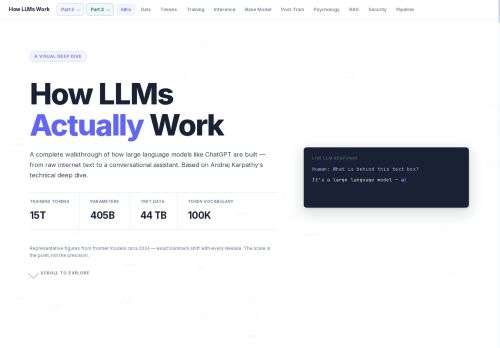
The resource documents data preparation steps—web crawling, language filtering, deduplication, and PII removal—and references representative corpora such as FineWeb and Common Crawl.It explains tokenization approaches like byte pair encoding (BPE), tokenizer vocabularies, and how token embeddings feed multi-head attention and transformer blocks.
Training topics include loss measurement, parameter updates across billions of parameters, and practical notes on sampling and autoregressive inference.The content targets ML researchers, engineers, data scientists, and students seeking a technical walkthrough of model internals, dataset curation, and deployment considerations.
Visualizations, stepwise walkthroughs, and live examples support debugging, model evaluation, and understanding generation behavior.
Key Features
- Pre-training and model internals coverage (transformer architecture, attention mechanisms)
- Tokenization methods and token embedding pipeline (BPE, tokenizer vocabularies)
- Data preparation pipeline (web crawling, language filtering, deduplication, PII removal)
- Training and inference procedures (loss measurement, large-scale parameter updates, sampling, autoregressive inference)
- Retrieval-augmented generation (RAG) and inference pipeline explanations
Use Cases
- Inspect and debug model behavior by visualizing tokenization (BPE merges), transformer attention maps, autoregressive inference traces and intermediate layer activations with LLMs Work's live examples and visualizations to pinpoint hallucinations, performance bottlenecks, and optimization targets without building custom tooling
- Curate and optimize datasets and RAG pipelines for fine-tuning by using LLMs Work to simulate training dynamics, evaluate retrieval strategies, visualize dataset coverage and failure modes, and generate interpretable metrics that accelerate domain adaptation and reduce trial-and-error
- Onboard engineers, researchers and product teams with interactive visual walkthroughs of LLM internals—pre-training, tokenization, attention mechanics, inference and deployment trade-offs—enabling collaborative debugging, informed architecture decisions, and clearer communication of model limitations to stakeholders
Who is it for?
- Ml researchers
- Engineers
- Data scientists
- Students
Based on 10 verified user reviews — Average rating: 4.30/5

@carolynhill3280
TurkeyNice discovery. Documentation could be clearer, but once you learn it, it is productive.

@denisestewart1745
TurkeyWhat surprised me about How LLMs work is how little friction there is once you set preferences. I keep a short checklist: audience, tone, must-include points, and forbidden phrases. With that, outputs are consistently usable. Without it, results feel generic. I also like that I can iterate quickly instead of restarting from a blank page. Missing features for me: better version history and clearer export options. Even so, it has replaced a couple of scattered tools in my stack. Rating reflects practical value in my week, not hype from the landing page.

@jeremyrivera9247
Turkeyİş akışıma gerçekten faydası oldu. Kurulumu kolaydı ve sonuçlar beklediğimden iyi çıktı.


@waynerivera5549
TurkeyHow LLMs work ile ilgili sürpriz, tercihleri ayarladıktan sonra sürtünmenin azalması oldu. Kısa bir kontrol listem var: hedef kitle, ton, zorunlu maddeler, istenmeyen ifadeler. Bunlarla çıktılar düzenli şekilde kullanılabilir oluyor. Olmadan sonuçlar genel kalıyor. Boş sayfadan başlamak yerine hızlıca iterasyon yapabilmek de büyük artı. Eksik gördüğüm yerler: daha iyi sürüm geçmişi ve net export seçenekleri. Yine de dağınık birkaç aracı elimden aldı. Puanım reklam değil, haftalık pratik faydaya göre.

@stephenmiller3297
TurkeyNice discovery. Documentation could be clearer, but once you learn it, it is productive.
More LLM AI Tools
Explore other llm tools with user ratings, pricing details, and in-depth descriptions. Updated regularly by our editorial team.