
About Openmed
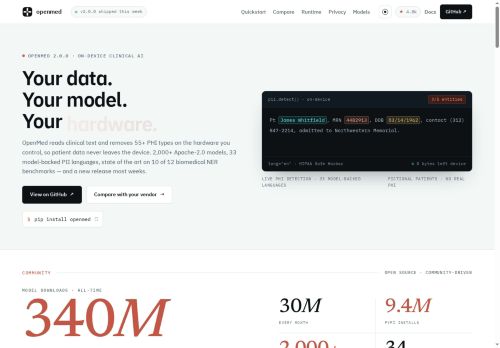
The runtime supports MLX acceleration on Apple Silicon and native Swift integration via OpenMedKit, plus composable Python APIs and batch processing for clinical workflows.Privacy controls include the nemotron privacy filter, deterministic faker-backed surrogate replacement, configurable redaction methods (mask, redact, hash, date-shift), and air-gapped operation with no external API calls.
Domain-aware validators and keyword boosting reduce false positives for locale-specific identifiers (SSN, NIR, Steuer‑ID, CPF/CNPJ) while smart entity merging reassembles fragmented tokens for accurate extraction.
Intended users include clinicians, healthcare researchers, and developers who need HIPAA Safe Harbor detection, local de-identification, and production-ready NER pipelines on macOS, iOS, and server environments.
Key Features
- On-device clinical AI for local-first PHI/PII detection, de-identification, and named-entity recognition in clinical text
- Model library of healthcare NER and LLM variants with curated biomedical datasets
- Multilingual NER and PII detection across multiple languages
- Runtime integrations: MLX acceleration on Apple Silicon, native Swift integration via OpenMedKit, composable Python APIs, and batch processing for clinical workflows
- Privacy and de-identification controls: nemotron privacy filter, deterministic faker-backed surrogate replacement, configurable redaction methods (mask/redact/hash/date-shift), air-gapped operation, domain-aware validators, and smart entity merging
Use Cases
- Create HIPAA-compliant de-identified datasets from EHR notes using openmed's on-device PHI detection and clinical de-identification pipeline, leveraging deterministic surrogate replacement and locale-aware identifier validation to preserve analytic utility while running air-gapped on macOS/iOS/servers
- Integrate multilingual medical NER and real-time PHI/PII redaction into telehealth or mobile health apps with openmed's on-device ML acceleration and 1,000+ model variants to automatically redact sensitive data offline, reduce latency, and maintain patient privacy
- Build a reproducible clinical ML data curation and QA workflow with openmed by extracting structured entities from free-text clinical notes, applying configurable privacy controls and HIPAA Safe Harbor detection, and producing compliant training cohorts for research without exposing PHI to the cloud
Who is it for?
- Clinical developers
- Data scientists
- Machine learning engineers
- Privacy officers
- Hospital it administrators
Based on 10 verified user reviews — Average rating: 4.20/5

@catherineroberts8601
TurkeyUsing Openmed regularly now. Saves time when the brief is clear.

@elizabethross2768
TurkeyWhat surprised me about Openmed is how little friction there is once you set preferences. I keep a short checklist: audience, tone, must-include points, and forbidden phrases. With that, outputs are consistently usable. Without it, results feel generic. I also like that I can iterate quickly instead of restarting from a blank page. Missing features for me: better version history and clearer export options. Even so, it has replaced a couple of scattered tools in my stack. Rating reflects practical value in my week, not hype from the landing page.

@charlesnguyen1066
TurkeyReally useful for my workflow. Setup was quick and the results were better than I expected.


@seanreyes962
TurkeyOpenmed umut verici. Birkaç özellik eksik olsa da çekirdek deneyim güçlü.

@nicholasstewart5379
TurkeyMenü kalabalığı yok, özellikler işe yarıyor. Pratik bir AI katkısı.
More Security and Privacy AI Tools
Explore other security and privacy tools with user ratings, pricing details, and in-depth descriptions. Updated regularly by our editorial team.