
About Openmed
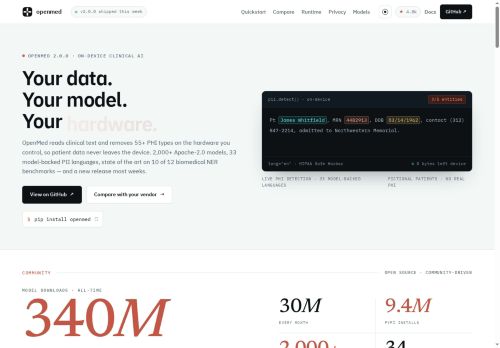
The runtime supports MLX acceleration on Apple Silicon and native Swift integration via OpenMedKit, plus composable Python APIs and batch processing for clinical workflows.Privacy controls include the nemotron privacy filter, deterministic faker-backed surrogate replacement, configurable redaction methods (mask, redact, hash, date-shift), and air-gapped operation with no external API calls.
Domain-aware validators and keyword boosting reduce false positives for locale-specific identifiers (SSN, NIR, Steuer‑ID, CPF/CNPJ) while smart entity merging reassembles fragmented tokens for accurate extraction.
Intended users include clinicians, healthcare researchers, and developers who need HIPAA Safe Harbor detection, local de-identification, and production-ready NER pipelines on macOS, iOS, and server environments.
Key Features
- On-device clinical AI for local-first PHI/PII detection, de-identification, and named-entity recognition in clinical text
- Model library of healthcare NER and LLM variants with curated biomedical datasets
- Multilingual NER and PII detection across multiple languages
- Runtime integrations: MLX acceleration on Apple Silicon, native Swift integration via OpenMedKit, composable Python APIs, and batch processing for clinical workflows
- Privacy and de-identification controls: nemotron privacy filter, deterministic faker-backed surrogate replacement, configurable redaction methods (mask/redact/hash/date-shift), air-gapped operation, domain-aware validators, and smart entity merging
Use Cases
- Create HIPAA-compliant de-identified datasets from EHR notes using openmed's on-device PHI detection and clinical de-identification pipeline, leveraging deterministic surrogate replacement and locale-aware identifier validation to preserve analytic utility while running air-gapped on macOS/iOS/servers
- Integrate multilingual medical NER and real-time PHI/PII redaction into telehealth or mobile health apps with openmed's on-device ML acceleration and 1,000+ model variants to automatically redact sensitive data offline, reduce latency, and maintain patient privacy
- Build a reproducible clinical ML data curation and QA workflow with openmed by extracting structured entities from free-text clinical notes, applying configurable privacy controls and HIPAA Safe Harbor detection, and producing compliant training cohorts for research without exposing PHI to the cloud
Who is it for?
- Clinical developers
- Data scientists
- Machine learning engineers
- Privacy officers
- Hospital it administrators
Based on 10 verified user reviews — Average rating: 4.20/5

@kevinbennett9365
TurkeyGünlük kullanım sonrası detaylı yorum: Openmed hız konusunda güçlü, brief netse kalite de iyi. Aynı görevlerde iki alternatifle kıyasladım (blog outline, toplantı notu sadeleştirme, kısa SSS). Openmed en hızlısıydı ve tonu en az garip olandı. Zayıf yanı uç vakalar — niş jargon ve çok adımlı isteklerde sapabiliyor. Bunu kayıtlı bir stil/prompt rehberiyle çözdüm. Haftada birkaç kez kullanıyorsanız fiyatı makul; değilse ücretsiz katman yetebilir. Freelancer ve küçük ekiplere, güvenilir ilk taslak için öneririm.

@ayerooks3472
TurkeyHızlı taslak için fena değil. Final müşteri tesliminde henüz güvenmem.

@illaoleman5653
TurkeyPretty solid overall. A few quirks, but I keep using it weekly.

@benjamingomez3967
TurkeyHelpful and mostly consistent. Would recommend for freelancers.

@theresahall3437
TurkeyUsing Openmed for drafts and summaries. Cuts friction without feeling complicated.
More Security and Privacy AI Tools
Explore other security and privacy tools with user ratings, pricing details, and in-depth descriptions. Updated regularly by our editorial team.