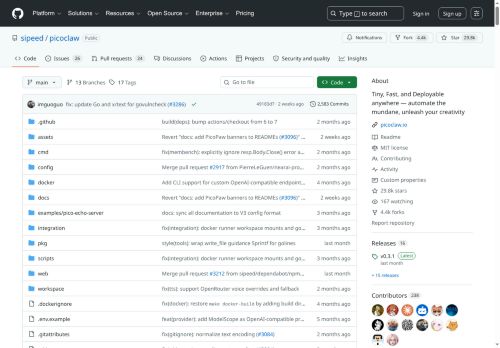

About PicoClaw
Picoclaw is an ultra-lightweight AI assistant written in Go for low-memory, fast-startup local deployment.
It runs with minimal resources (≈10 MB RAM,
Key Features
Use Cases
Who is it for?
It runs with minimal resources (≈10 MB RAM,
Key Features
- Ultra-lightweight Go implementation for local deployment with low-memory footprint and fast startup
- Multi-model support with optional LLM API key configuration (OpenAI, Anthropic, OpenRouter, Zhipu, Deepseek, Groq)
- Integrations for messaging platforms (Telegram, Discord, QQ, DingTalk) plus a one-command gateway for bot deployment and workflow integration
- Core capabilities: interactive chat, long-term memory and skill systems, local code completion and debugging, content generation, and data analysis
- Single-binary deployment with installers for Linux/macOS/Windows and Docker, and a REST API for embedding into custom applications
Use Cases
- Create a private on-device coding assistant for embedded and edge developers using picoclaw's single-binary, multi-arch support and local code completion to provide instant, low-latency chat and code suggestions on x86_64/arm64/RISC-V boards with ≈10MB footprint and <1s startup, removing cloud dependencies and protecting IP
- Deploy a lightweight messaging bot on IoT gateways and home servers using picoclaw's messaging integrations, REST API, scheduled tasks and memory to handle alerts, automate commands, translate messages and archive conversations locally with minimal RAM for battery-operated or constrained environments
- Host a compact, secure AI helper for small teams and on-prem services leveraging picoclaw's multi-LLM support, chat, memory and code tools—single binary deployment enables private Q&A over internal docs, scheduled summaries and automated documentation generation without sending data to external servers
Who is it for?
- Embedded systems developers
- Chatbot developers
- Automation engineers
- Machine learning engineers
- Software developers
No review yet!
More AI Agents AI Tools
Explore other ai agents tools with user ratings, pricing details, and in-depth descriptions. Updated regularly by our editorial team.