
About Plori AI
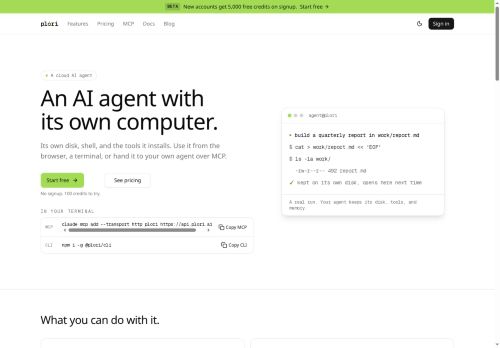
Plori provides a cloud AI agent computer that runs persistent agent instances with disk, shell, and installable tools.Agents access a browser and terminal, retain disk state and long-term memory, and resume work across sessions.
A CLI and MCP API endpoint enable terminal-driven workflows, model integration, and programmatic automation.Workflows support scheduled runs, background tasks, webhooks, and unattended execution of test suites or migrations.
Agents can publish a served directory as a site, run in isolated environments, and use account-scoped storage when needed.Plori targets developers, ML engineers, and teams needing hosted AI agents, reproducible development environments, automated agent-driven workflows, and model integration.
Key Features
Use Cases
Who is it for?
A CLI and MCP API endpoint enable terminal-driven workflows, model integration, and programmatic automation.Workflows support scheduled runs, background tasks, webhooks, and unattended execution of test suites or migrations.
Agents can publish a served directory as a site, run in isolated environments, and use account-scoped storage when needed.Plori targets developers, ML engineers, and teams needing hosted AI agents, reproducible development environments, automated agent-driven workflows, and model integration.
Key Features
- Persistent agent instances with disk, shell, and installable tools
- Browser and terminal access for agents
- Retained disk state and long-term memory with cross-session resume
- CLI and MCP API for terminal-driven workflows, model integration, and automation
- Workflows supporting scheduled runs, background tasks, webhooks, and unattended execution
Use Cases
- Create reproducible, resumable development environments with Plori's persistent cloud agents, using disk, shell and browser access to run long-running experiments or training jobs, resume sessions later, schedule unattended workflows, and serve models and logs via served directories for team collaboration
- Automate end-to-end ML pipelines and CI/CD by orchestrating CLI/API-driven Plori agents to fetch data, run preprocessing and training in isolated execution, persist artifacts to disk, use long-term memory to track dataset and config versions, and schedule background retraining or evaluation
- Set up autonomous developer assistants to handle routine engineering tasks—use Plori agents as terminal-driven bots to run tests, reproduce bugs in isolated environments, collect debugging artifacts to served directories, and retain contextual long-term memory to recall past issues and resolutions
Who is it for?
- Developers
- Devops engineers
- Mlops engineers
- Quality assurance engineers
- Data scientists
No review yet!
More AI Agents AI Tools
Explore other ai agents tools with user ratings, pricing details, and in-depth descriptions. Updated regularly by our editorial team.